


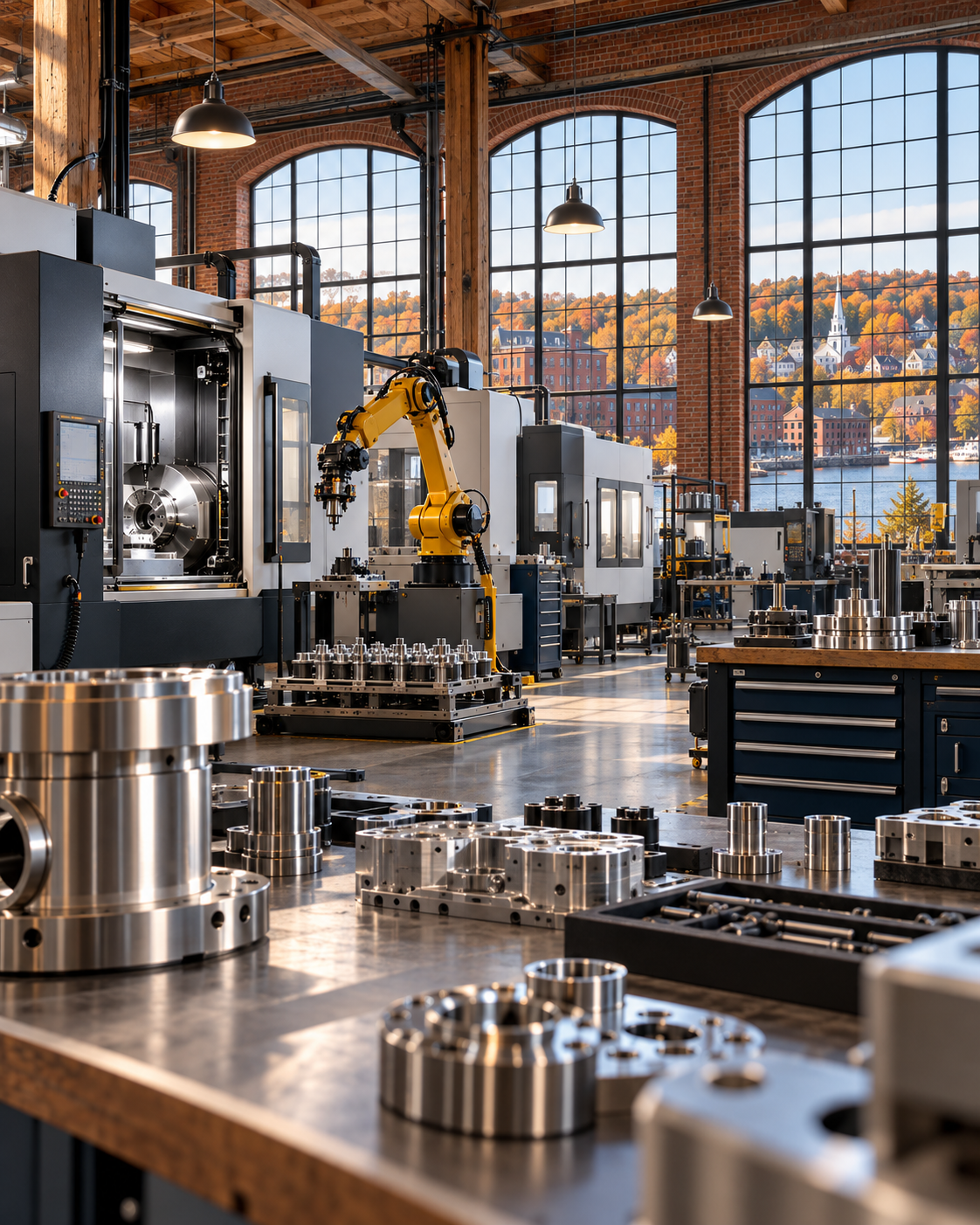
From precision machining and aerospace components to medical devices and advanced materials, New England manufacturers are helping redefine the future of American industry. In “Built in New England: How Regional Manufacturing Is Shaping the Future of American Industry,” we explore how manufacturers across the Northeast are combining generations of industrial expertise with modern technology, strategic partnerships, and renewed investment in domestic production. As companies rethink global supply chains and look for greater flexibility, quality, and reliability, New England’s manufacturing sector is demonstrating why regional production remains an important competitive advantage.
New England has a long and influential history in American manufacturing. From the textile mills of Massachusetts and New Hampshire to Connecticut’s aerospace industry and Maine’s shipbuilding tradition, the region helped establish the industrial foundation of the United States. Today, that legacy continues through a sophisticated network of manufacturers producing everything from precision-engineered components and medical devices to specialized electronics, advanced materials, and complex industrial equipment.
While manufacturing has evolved dramatically over the past several decades, the Northeast remains an important center for innovation, technical expertise, and specialized production. As businesses navigate global supply chain uncertainties, workforce challenges, and rapidly advancing technology, New England manufacturers are finding new opportunities to compete by emphasizing precision, adaptability, and strong regional relationships.
The Renewed Value of Regional Manufacturing
For decades, many American companies prioritized overseas manufacturing to reduce production costs. While international sourcing continues to play an important role in global commerce, recent supply chain disruptions have encouraged businesses to reconsider the advantages of domestic and regional manufacturing partnerships.
Long shipping distances, unpredictable lead times, transportation expenses, and international trade uncertainties can create significant challenges for companies relying heavily on overseas suppliers. For businesses requiring specialized components, strict quality standards, or frequent design modifications, these challenges can become particularly costly.
New England manufacturers offer an alternative built around proximity, responsiveness, and collaboration. Working with regional suppliers allows businesses to communicate more directly with production teams, conduct facility visits, address quality concerns quickly, and make adjustments without navigating international logistics.
For industries such as aerospace, defense, medical technology, and precision engineering, the ability to maintain close relationships with manufacturing partners can provide substantial operational advantages.
Rather than competing exclusively on price, many regional manufacturers are positioning themselves as valuable partners capable of delivering specialized expertise, consistent quality, and dependable service.
Precision Manufacturing as a Regional Strength
One of New England’s greatest manufacturing advantages is its concentration of companies specializing in high-precision production.
Across Connecticut, Massachusetts, New Hampshire, Rhode Island, Vermont, and Maine, manufacturers operate sophisticated machining, fabrication, molding, and assembly facilities serving customers throughout the United States and internationally.
These businesses frequently produce components requiring extremely tight tolerances, advanced materials, and extensive quality control. Industries such as aerospace, medical devices, semiconductor equipment, and defense depend on these capabilities to manufacture products where reliability and precision are essential.
Modern computer numerical control (CNC) machining systems, automated inspection equipment, advanced metrology tools, and digital production software allow manufacturers to achieve exceptional levels of consistency and repeatability.
Equally important is the technical knowledge developed through decades of hands-on experience. Skilled machinists, engineers, toolmakers, and production specialists continue to provide the expertise necessary to manufacture increasingly complex components.
This combination of advanced equipment and specialized knowledge allows New England manufacturers to remain competitive in markets where quality, engineering collaboration, and technical problem-solving often outweigh production volume.
Technology Is Transforming the Factory Floor
Manufacturing facilities throughout the Northeast are adopting technologies designed to improve productivity, reduce waste, and increase operational flexibility.
Automation, robotics, connected machinery, artificial intelligence, and real-time production monitoring are becoming increasingly important components of modern manufacturing operations.
Automated machining centers and robotic material-handling systems can operate with reduced manual intervention, allowing manufacturers to increase output while maintaining consistent quality. Digital monitoring systems provide greater visibility into equipment performance, production schedules, and maintenance requirements.
For smaller manufacturers, these technologies can help address workforce limitations while improving efficiency and expanding production capabilities.
Additive manufacturing, commonly known as 3D printing, is also creating opportunities for rapid prototyping, custom tooling, and specialized component production. Engineers can test designs, refine products, and manufacture certain components more efficiently without relying entirely on traditional manufacturing processes.
The goal is not simply to replace established production methods, but to integrate new technologies with existing capabilities.
Manufacturers that successfully combine automation with skilled employees are better positioned to respond to changing customer needs, maintain quality standards, and compete in demanding industrial markets.
Strengthening Regional Supply Chains
The growing emphasis on supply chain resilience presents a significant opportunity for New England’s manufacturing community.
Large manufacturers increasingly recognize the importance of identifying reliable suppliers capable of providing components, materials, and services closer to their primary operations.
This creates opportunities for regional machine shops, metal fabricators, plastics manufacturers, electronics producers, and industrial service providers to establish new relationships within their local manufacturing ecosystems.
A Massachusetts medical device manufacturer, for example, may benefit from working with a New Hampshire precision machining company, a Connecticut specialty materials supplier, or a Rhode Island plastics manufacturer.
These regional connections can shorten transportation distances, improve communication, and create greater flexibility when production requirements change.
Strong supplier relationships also encourage collaboration during product development, allowing manufacturers to identify potential design improvements, reduce production costs, and address technical challenges earlier in the process.
As companies place greater emphasis on reliability and adaptability, building stronger regional supplier networks will remain an important strategy for supporting long-term growth.
Developing the Next Generation of Manufacturing Talent
Despite technological advancements, workforce development remains one of the most significant challenges facing manufacturers throughout New England.
Many experienced manufacturing professionals are approaching retirement, creating growing demand for skilled machinists, technicians, engineers, maintenance specialists, and production managers.
At the same time, perceptions of manufacturing careers have not always kept pace with the industry’s transformation.
Today’s manufacturing facilities increasingly feature advanced robotics, sophisticated software, precision equipment, and highly technical production environments. Employees often work with technologies requiring specialized training, problem-solving abilities, and continuous professional development.
To address workforce challenges, manufacturers are strengthening relationships with vocational schools, community colleges, technical training programs, and universities.
Apprenticeships, internships, industry certifications, and employer-supported training initiatives are providing alternative pathways into manufacturing careers.
Regional collaborations are also expanding. In 2026, the New Hampshire Manufacturing Extension Partnership established its primary office at the University of New Hampshire’s John Olson Advanced Manufacturing Center, strengthening connections among manufacturers, researchers, students, and workforce development resources.
These partnerships are essential to ensuring that New England manufacturers have access to the talent needed to support future innovation and growth.
Innovation Through Collaboration
One of New England’s defining advantages is the proximity of its manufacturing companies to universities, research institutions, engineering firms, and technology developers.
The region’s concentration of technical expertise creates opportunities for collaboration that can accelerate product development and commercialization.
Manufacturers working alongside research institutions and engineering partners can explore new materials, develop specialized production processes, and test emerging technologies.
These relationships are particularly valuable in industries such as medical technology, biotechnology, aerospace, renewable energy, and advanced electronics, where innovation frequently requires close coordination between research, engineering, and production teams.
For small and midsize manufacturers, access to these partnerships can provide capabilities that might otherwise require significant internal investment.
By sharing expertise and resources, regional companies can pursue new markets, improve existing operations, and develop products that strengthen New England’s position in advanced manufacturing.
The Future Is Being Built Locally
New England manufacturing continues to evolve, but its underlying strengths remain remarkably consistent. Technical expertise, craftsmanship, innovation, and strong business relationships have supported the region’s industrial economy for generations.
Today, these advantages are being reinforced by advanced technologies, renewed interest in domestic sourcing, stronger regional supply chains, and collaboration between industry and education.
Challenges remain, particularly around workforce availability, operating costs, and the pace of technological change. However, manufacturers that invest in modern equipment, workforce development, and strategic partnerships will be better positioned to adapt and grow.
The future of American manufacturing will not be defined solely by large-scale factories or the lowest production costs. It will also depend on the ability to deliver specialized solutions, maintain dependable supply networks, and respond quickly to increasingly complex customer needs.
For New England manufacturers, these capabilities represent more than a continuation of the region’s industrial heritage. They represent an opportunity to help shape the next generation of American manufacturing.
New England has always been a place where innovation meets craftsmanship. Today, that combination is helping build a stronger, more resilient future for American industry.
