


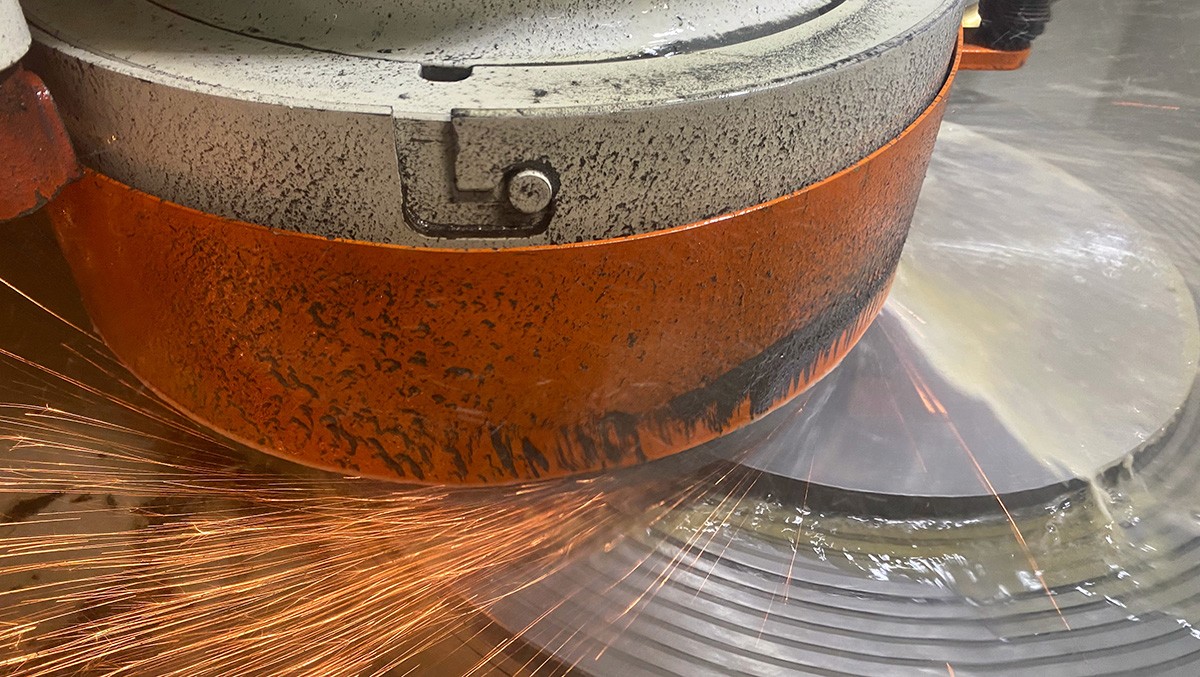
To combat the loss of more seasoned operators to retirement, job shops are turning to more modern, automated surface grinders. Machine shops that grind metal or alloy surfaces flat to remove material or achieve a precise thickness now have “endless possibilities” to improve their precision as well as production speed and control with more advanced, automated units.
Today’s rotary surface grinders offer sophisticated sensors and controls that can reliably achieve tighter dimensional tolerances, flatness, parallelism, and surface finish in much less time. The equipment can be used to grind flat metals, alloys, and ceramics to precise dimensions before polishing.
Operator control over the process is unsurpassed with the new automated grinders. The user can enter the specific requirements, for example: 712 RPMs on the spindle, 22 RPMs on the table, with a down-feed rate of .003 inches per minute, with a certain dwell cycle. Essentially, the machine can be programmed to meet just about any requirement.
Compared to traditional grinding equipment with manual controls that require experienced machinists familiar with the nuances of each machine, these automated units consistently produce higher quality parts in less time. As a result, a growing number of machine shops are installing new grinders that can be operated by less experienced personnel while still achieving the desired results.
Solving The Skilled Operator Retirement Problem
In machine shops that work with metals and alloys, factors such as thickness, parallelism, and surface condition are often dictated in the specifications. Grinding is also often utilized to remove significant amounts of material to bring a stock sheet or plate to precise dimensions.
To do this, machine shops primarily utilize surface grinders with a reciprocating table and a horizontal spindle that turns the grinding wheel, but the process is very slow.
“Reciprocating table grinders are precise, but the material removal rate is slow and multiple passes are required,” says Erik Lawson, Engineering Manager at Winona, MN-based DCM Tech, a designer and builder of industrial rotary surface grinders.
Older rotary surface grinders are another option but can be problematic in the hands of less experienced operators. With limited control of spindle speeds as well as manual controls, the older equipment requires sophisticated operators that can factor in complex calculations. Considerable expertise and experience are required, which can be a challenge as skilled operators retire.
Automated Rotary Surface Grinders
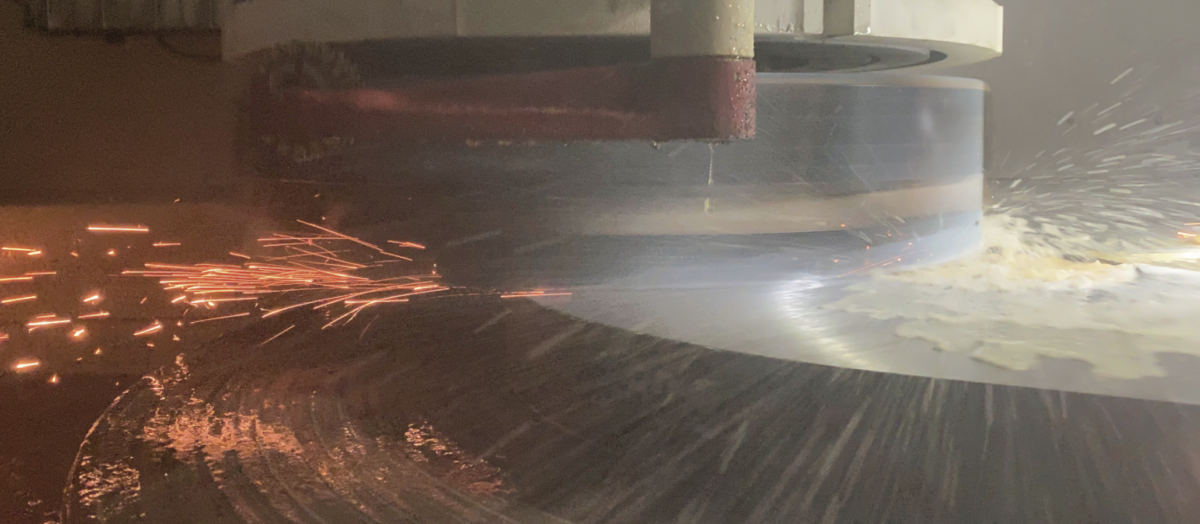
In modern vertical spindle, rotary table surface grinders, the table rotates with the workpiece held firmly in place underneath a vertical spindle. The grinding is not performed by the peripheral edge of the wheel, but by the entire diameter of the abrasive surface, which facilitates grinding performance and consistency.
“With rotary table surface grinders, the entire part passes through the wheel, which is more efficient than reciprocating table grinders that may have workpieces wider than the grinding wheel,” says Lawson.
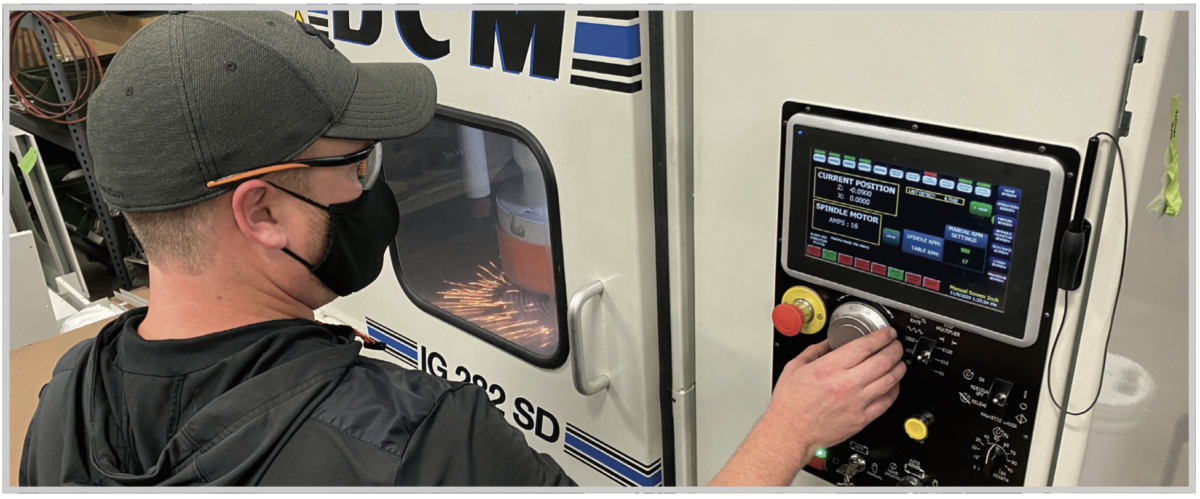
Today, surface grinders are designed with much more advanced sensors and controls that automatically maintain very tight tolerances, removing material down to within one ten-thousandth of an inch of the final thickness. Digital technology allows for an interface with easy-to-use touchscreen controls. When combined with automation, surface grinder operators are no longer required to be highly trained individuals.
For example, rotary units such as DCM Tech’s IG 280 SD, with a 24” variable speed table and 20HP variable speed grinding spindle motor, make it possible for virtually anyone to successfully operate a unit. One example of innovation available in this model involves the automation of the initial contact between the abrasive wheel and the part, which typically had to be finessed by the operator. With this updated option, advanced sensor technology detects vibration and can automatically fine- tune not only the pressure of the spindle motor but how quickly it moves the wheel down onto the part. When the machine senses the abrasive wheel has contacted the part, it automatically begins the grind cycle.
“Automatic part detection eliminates the need for the operator to do time consuming, error prone ‘manual touch offs’ where they would manually feed the [grinding] machine until it just touches the surface of the part before backing off and restarting it,” says Lawson.
