


Machine Shop Utilizes Forging Press To Reduce Costs Of Titanium Parts
Savvy machine shops are adding advanced forging equipment to create precision titanium components at a lower cost, in volume
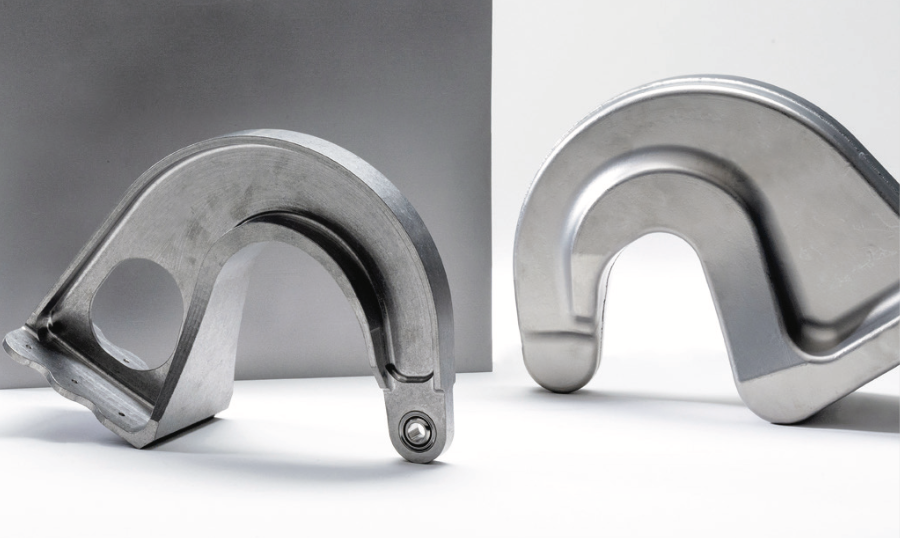
To produce complex titanium parts more cost-effectively, machine shops are increasingly incorporating advanced forging equipment to complement their existing CNC capabilities to create near-net-shaped parts that only require minimal machining. In some cases, the forging process is so precise that no additional machining is required.
There are significant advantages to include forging in a machine shop’s repertoire. With recent advances in the controls and automation of hydraulic forging presses, precision titanium parts can be forged to extremely tight tolerances, and at relatively high volume. Forging also significantly lowers titanium input costs by as much as 50%.
To forge titanium to precise specifications, however, machine shops require the right equipment with exceedingly tight control of the production parameters. Fortunately, advances in hydraulic press design, controls, and automation are helping to optimize component quality, production, and price.
To cost-effectively produce large, complex titanium parts, Pennsylvania-based FPD Company, a machine shop that produces aerospace and medical components, decided to invest in a unique new custom press capable of greater control with higher tonnage.
“We wanted to increase our forged parts envelope, and that required a larger press with more sophisticated controls for the titanium parts. We already had a 2,500-ton press, which is relatively small for titanium. At the same time, we needed to improve control, quality, and cycle times.” – Jeff Speicher, General Manager of FPD
To achieve its production goals, FPD partnered with Erie Press Systems, a manufacturer of mechanical forge presses and individually engineered hydraulic presses since 1895 that is now part of the largest forging equipment supplier in North America: Ajax-CECO-Erie Press.
Although Erie Press designed, engineered, and built the system, FPD provided significant input on the design requirements. The result was a customized high-speed hydraulic press capable of producing 3,000 tons at a fully controlled, programmable speed and load profile through full travel.
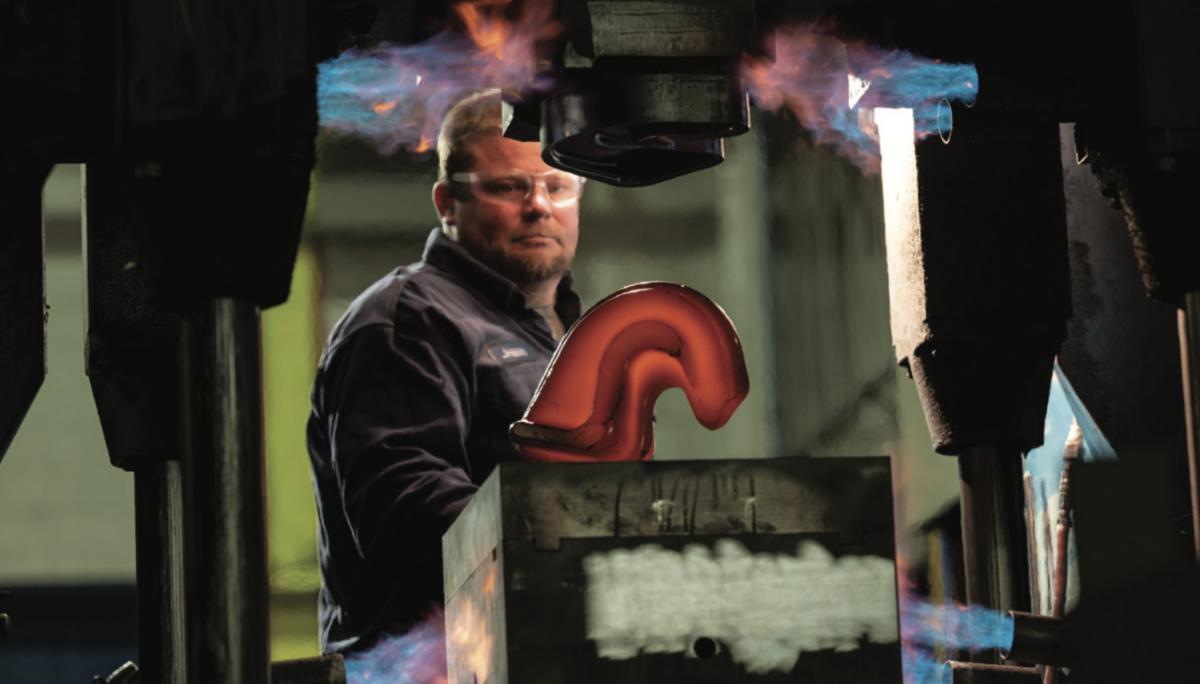
“The custom press, along with our engineering and tooling, allows us to hold extremely tight tolerances consistently when creating titanium parts for the aerospace and medical device industries. With the right equipment, the forgings are extremely consistent, and we can produce near-net shapes that require minimal to no machining. If a part needs additional machining for holes, bores, and other secondary features, we can do that as well,” explains Speicher, adding that FPD provides extensive 5-axis CNC machining services on site.
Precise Control of Forge Stroke, Force
According to Speicher, the Erie Press forging equipment is designed with a unique servo hydraulic system that allows greater control of the forging stroke and applied force. The press control modulates the servo proportional accumulator discharge valves to maintain the programmed velocity regardless of the load, ensuring consistent forging performance. This arrangement provides flexibility to forge parts across a wide velocity range not possible with a mechanically adjusted accumulator discharge rate configuration.
For some part geometries, the deformation rate of the titanium may require variable velocity profiles throughout the forming process. Altering the deformation rate enables FPD to achieve improved die life while creating greater detail by filling the die cavity webs and corners later in the stroke. According to Speicher, the servo-hydraulic system allows extremely high resolution in defining those parameters. Furthermore, the press position controller publishes (to FPD’s plant server) a high-speed plot or digital signature corresponding with each part’s forging cycle for historical records and reference.
FPD can also control the press to strike the part at a specific force or to a pre-defined tonnage limit. In addition, the press can stroke to a programmed position within a positional accuracy of less than .01”.
Erie Press’s Human-Machine Interface (HMI) allows operators to see how the press functions and anticipate how it should be performing. This is accomplished with dynamic animated models and schematics, live trending, and diagrams.

The HMI is a software application that graphically presents information to operators about the state of various processes in a format that looks like the actual machine or display panel. The information can be accessed locally (at the machine) or remotely (within the plant or offsite) via PC, laptop, or smartphone.
“Erie Press incorporated a very user-friendly, graphics-based HMI into the design that can walk even someone unfamiliar with the forging process through it step by step,” says Speicher, adding that the forging press manufacturer’s HMI system is a virtual “digital twin” of the actual machine as it functions.
“The press has sensors that monitor the ram position, pump output, valve positions, etc. and all these parameters are monitored in a digital representation of the press. With the HMI, the operator sees how the machine is performing in real-time,” adds Speicher.
The HMI also helps operators monitor what is happening with enough insight to successfully troubleshoot and promptly get the equipment back online when required. For example, operators can quickly “drill down” from a top-level animated schematic to review the performance of specific components, such as valves and pumps, and locate information on part numbers and wiring schemes. Up-to-date PDF technical documents and the schematics of each component on the machine are also searchable and can be quickly displayed as needed.
The Erie Press forging equipment incorporates automation that enables the operator to change- out hot dies in less than ten minutes. A forging change-over is completely hands-off, requiring only inputs to the HMI. Titanium billet and workpieces are pre-heated in an electric furnace, while the tooling is pre-heated offline. The operator, working behind an interlock gate system for safety, uses a joystick to transfer the tooling into the press, which is hydraulicly clamped into place. A barcode is scanned on the production router, which calls up a part-specific forging program in the controller.
FPD worked with Erie Press to incorporate safety features such as preventing the program from executing if the bar codes of the toolsets and parts do not match the router, and a safety stroke the operator must execute before proceeding to automatic mode.
“Because we produce a lot of short runs, we can set up multiple times a day and this gives us tremendous production capacity,” says Speicher.
Extending Longevity, Lowering Cost
Controlling stroke speed has also helped to prolong tool life.
“With the hydraulic servo control, the operator can vary the press’s stroke speed with far more control, which prolongs tool life. According to our internal statistics, the new press has extended tool life by about 50%,” says Speicher.
There are also significant cost savings versus the conventional machining approach. “Depending on the part geometry, we can normally reduce unit price in the 30% to 50% range over a hog-out part [machined from bar, plate, or billet]. That is due to using less input material – and titanium is very expensive,” explains Speicher.
For machine shops, adding advanced forging of titanium parts to their existing machining capability can not only help to improve production speed and control but also significantly lower input costs – all which boosts the bottom line.

Further Information
Please visit the Ajax-CECO-Erie Press website at www.AjaxErie.com or e-mail them at info-sales@AjaxErie.com. Or, if you prefer, call 814-455-3941. Also, visit the FPD Company website at www.fpdcompany.com or contact Jeff Speicher, Mike McAllister, or Dan Gordon for inquiries at 724-731-2137.
