
Written by Paul Critchley
As Lean practitioners, we spend a lot of time talking about and focusing the removal of wasteful practices and non-value-added work. This includes everything from moving parts around the shop to routing paperwork through an office – pretty much anything that doesn’t move our product or service closer to the customer. But there’s one waste – in my opinion, the biggest one of all – that we don’t talk nearly enough about: the waste of employee turnover. It’s a huge problem – in the United States alone, 4.5 million workers quit their job every month! It’s gotten so bad that it has its own name – The Great Resignation.
The Waste Of Employee Turnover

Gallup surveys over the years consistently reveal that 67 percent of workers were either “not engaged in” or “actively disengaged from” their work, so it’s not hard to understand why so many of us quit our jobs. Forget about getting anyone excited about Continuous Improvement or putting in the extra effort that it takes to sustain those improvements…
If folks already have one foot out the door, they probably aren’t willing to take on anything “extra”, and even if they do, they aren’t putting forth their best efforts. And can we blame them? Consider this: Monday through Friday, we spend more time at work than we do with our families, so why get out of bed every day, and go to a place where you’re not appreciated, or where the work isn’t fulfilling?
When someone leaves an organization, we have little choice but to jump into “reactive mode” to find a replacement: we place ads, make calls to recruiters, schedule phone interviews, coordinate bringing people for onsite visits, perform background and drug screens… On average, it takes 30-45 days and 20- 30% of the previous person’s salary just to find a replacement person, and all of that takes place prior to one second of productive work being accomplished by the new hire. Until this process has played itself out, those employees that are still around must pick up the slack from the departed teammate, which further deteriorates their job satisfaction. It’s a bit of a catch-22, but is it really any wonder why so many of us leave in search of greener pastures?
Although strides may have been taken within the organization to ensure that all our documentation was up to date and standards were set accurately (Work Instructions, SOP’s, Procedures and Forms), those who depart our organizations still take valuable things with them: The relationships they’ve formed with our customers and suppliers, the knowledge of our business systems and “how things really work”, and (perhaps the most important) the emotional investment of themselves that they’ve made into our businesses. None of these things are easily replaceable, and even when we get lucky enough to do so, we certainly cannot do it quickly.
Lean, Respect For People And Keeping Your Employees
I’ll admit that all of that sounds pretty bleak. The state of our economy doesn’t make it feel much better, either. The good news, though, is that all is not lost!
By practicing Lean principles, we can evolve from being reactive to being proactive, and especially when it comes to our people. Within any organization, in any industry, our people are our greatest assets. They hold the keys to our relative success or failure, and we should treat them as such. Kevin Hancock, CEO of Hancock Lumber in Casco, ME turns an old adage on its head. “We used to say that the customer comes first”, says Kevin.
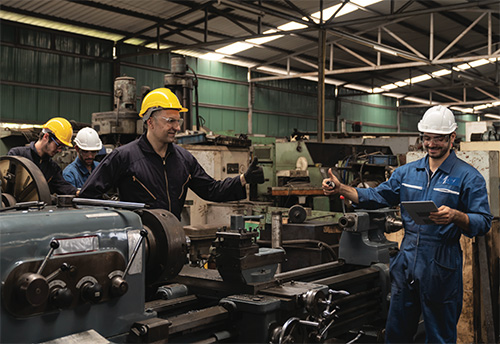
“At Hancock Lumber, we say that employees come first, and customers are a wicked close second.” He goes on to explain how, if a company takes care of its employees, in turn they’ll take care of the customers. By taking this approach, not only are customers taken care of (which is the ultimate goal of any business), but the organization avoids all of the costs and disadvantages that come along with employee turnover.
Set A Vision For A Better Future
Although it does take effort, the steps to ensuring that people want to stay with your organization are easier than you may think, and are certainly less costly and more productive than the alternative. The first step is to Set a Vision, which means creating (and sharing!) a plan for the future that is so compelling that employees will want to invest themselves in it. Ultimately, we’re trying to help employees become fans of our organization. Imagine what life would be like if work was a place that people actually looked forward to going every day… a place they felt supported, trusted, and listened to. A place like that wouldn’t be a place people would be looking to leave… and the business is better for it!
Successful Lean organizations employ this model and enjoy all the financial and marketplace benefits that come along with doing so. Aside from that, though (and perhaps most importantly) they have a workforce that’s engaged, motivated, and inspired to get up, come to work every day and do their absolute best work. When you have a workforce that’s like that, you’re awfully tough to beat!
Paul is a former Board Member of the Northeast Region of AME, holds a B.S. in Mechanical Engineering, a M.S. degree in Management and a M.S. in Organizational Leadership.
He is passionate about Lean and creating organizational cultures that are sustainably engaged. He co- authored his first book – The Whole Professional, A Collection of Essays to Help You Achieve a Full and Satisfying Life to bring a fresh perspective on Work/Life Balance and how individuals and organizations can work together to achieve greater levels of attainment.