



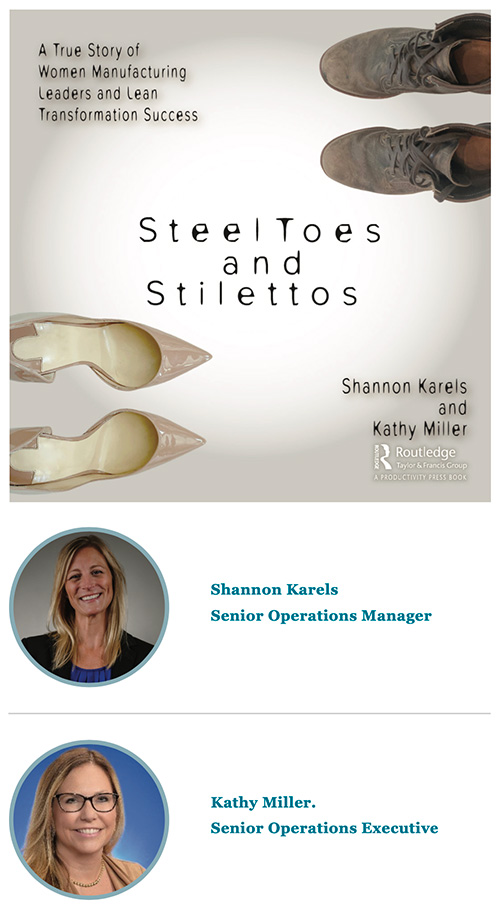
Back in Q1 Shannon Karels and Kathy Miller released their book, “Steel Toes and Stilettos,” a book about the journey the two manufacturing business leaders went on to transform a traditionally run batch operation into a lean enterprise— characterized by authentic leadership, an inclusive culture, and excellent business results.
Shannon Karels is a Sr. Operations Manager who has led multiple lean transformations and run operations for two large publicly traded corporations across various industries. She started her career in supply chain management and progressed through lean and operations leadership roles.
Kathy Miller is a Senior Operations Executive who has held numerous global vice president and director roles both in manufacturing and lean enterprise leadership. Kathy is a Shingo Prize Recipient for Large Businesses as a Plant Manager. She started her career in Operations as a 17-year-old co-op student at a vehicle assembly plant, and progressed through engineering, marketing, lean, and operations leadership roles, working for four large publicly traded corporations in executive roles.
The Gateway caught up with the two to discuss their book and gain some insight into their experience within the industry. First of all, let’s talk about your book, “Steel Toes and Stilettos.” Right out of the gate that line conjures up quite the image.
What were your goals behind this project? What was the impetus that led you to write it?
K&S: We wanted the title to be meaningful and memorable and send the message that being successful in what has traditionally been a man’s world does not have to be mutually exclusive from the feminine traits that are part of our identity. We hoped that right at the book cover, we would inspire and empower women in STEM careers and those thinking about entering it. Additionally, we realized we had a really good story of successfully transforming manufacturing cultures and processes based on lean thinking, tools, and methodologies. Although not overly prescriptive, we offer a roadmap to those aspiring to transform their operations toward greatly improved operational performance. We want factories and the people who work in them to thrive.
How’d you meet your partner in crime (co-author) for this book? How does each part of this tandem add to the overall narrative that is within these pages? In other words, what did you both bring to the table, and when did you decide, ‘yeah, this is an interesting idea; let’s run with it.’?
K&S: We met when Kathy, the Global Vice President of Lean, Quality, and Strategy Deployment was visiting the plant Shannon (Supply Chain Manager) was working in to do a review. Kathy needed to borrow a pair of safety shoes for the plant tour and was taken to the visitor closet to choose from a vast array of men’s safety shoes – none of which would fit. Shannon, upon witnessing the dilemma, came forth and offered Kathy to borrow her shoes. Fortuitously, we wore the same size shoe! (Of course, this story of the origin of our relationship contributed to the book’s title as well.) A couple of years later, a lean manager position became available at the division Kathy was responsible for and that’s how we started working directly together.
In “Steel Toes and Stilettos,” we offer different perspectives of the story. Kathy’s perspective is from the General Manager position where she was responsible for the P&L and all functions within the business. Shannon’s perspective was from the change agent, responsible for driving the business transformation at all levels of the organization. Although our objectives were the same, we felt that offering the story from each role would appeal to a wider audience. The facts of the events were the same, but our respective perspectives could be vastly different. This is true in almost everything that takes place in life that involves multiple people.
We also have very different personalities and strengths. We wanted to show how we leveraged these, as well as the rest of the teams to enable our success. Diversity of thought produces better results. For example, Kathy excels at creating inclusive cultures where everyone’s voices are heard, it sets a clear vision, and creates teams to help implement that vision. Shannon’s strengths lie in her ability to take the vision and determine all the details to execute it successfully.
What led you to make a career within the manufacturing industry?
Kathy: I needed a way to pay for college and found a co-op program at GMI (now Kettering University) where you could work for 6 months in a plant as a paid cooperative education student and go to school for the other 6 months of the year. It allowed me to get an education without so much financial debt. So, as a 17-year-old I started to work in a vehicle assembly plant as a Suggestions Coordinator. I fell in love with a functioning vehicle coming off the end of a moving assembly line every 60 seconds, and I was in and around manufacturing for most of the rest of my corporate career thereafter.
Shannon: I was recruited for my supply chain degree by a large manufacturing company right out of college. I spent my first 10 years or so in various supply chain functions working in the plants, then moved into lean and operations leadership roles thereafter. I’ve spent my career in various industries in the manufacturing sector.
What are a few things you know today that you wish you’d known (and could lean on) back when you began?
Shannon: I wish I had known that when they say “patience is a virtue” to apply that and give yourself
and others a little grace to not be perfect. It will all work out without putting extreme pressure on yourself.
Kathy: I wish I had known about resilience skills much earlier in my career. Always a competitive and dedicated team member, I took all the goals and challenges very seriously. Sometimes this led to more short-term angst than was productive for a long career in and around Operations. Somewhere along the line, I learned to breathe before reacting!
What’s the significance of Lean manufacturing? You lean (see what I did there) on this topic substantially as a driving force for the dialogue within this book.
K&S: Lean manufacturing is a set of tools and methodologies based on the Toyota Production System introduced many decades ago. The foundation of this operating system is respect for people, with the goal of getting products to the customer at their rate of demand. This is accomplished by eliminating as much waste in processes as possible. We were both offered the opportunities to learn about and apply these concepts to businesses we were in earlier in our careers. They became core to how we lead businesses and generate transformational performance results.
What are you hoping people take away with them when they read “Steel Toes and Stilettos”?
K&S: We hope that people can relate to our story and see that there are tools and techniques available to create positive work cultures while achieving excellent business results. We also hope that we show that staying true to your authentic self and leveraging your strengths to contribute is possible! Finally, by developing positive workplace relationships and acknowledging and addressing the realities of the business environment, you can generate impressive performance results.
What did you get out of writing it?
Shannon: Revisiting my leadership journey throughout the story and how I grew, was a great reminder of the type of leader I want to be. I can use that experience to share lessons learned with others and help them grow as well.
Kathy: The book is one way to get my message out into the world. I am passionate about successful manufacturing, as I owe much of what I have in my life to this industry. Through my decades of experience and my recent education in Positive Psychology, I have compelling evidence of how creating inclusive environments in this environment contributes to thriving businesses that generate impressive results. The book enables me to spread this message to more people in a means that is digestible, and hopefully enjoyable. (People like to read stories.)
Another topic you hit on quite heavily is inclusion within the workplace. Can you speak to the strides that have been made to bring that to the forefront in today’s manufacturing world, and, what work is left to be done to keep that train rolling?
K&S: We have seen the entire spectrum of organizational inclusion in the many plants we have worked with and toured. We are strong advocates that inclusion needs to be a central part of an organization’s culture, through its values and its processes. Inclusion should not be a buzzword that appears in formal presentations only. It must be the core element of the actions of organizational leadership.
It starts with leaders spending time with their teams where work takes place and developing positive relationships with the members of that workforce, whether in the offices or on the shop floor. Active listening and honest feedback are core ingredients in developing positive workplace relationships that embody trust. Processes must also support this philosophy. Giving employees the training to contribute to their work environment through problem-solving or initiation of proactive initiatives that are meaningful to them reinforces that the leadership team values everyone’s input. When teams learn what boundary conditions exist for their ideas (for example, there are no unlimited funds, or quality and safety must never be compromised), and see that many of their ideas do contribute to the mission and success of the organization, more effort and loyalty naturally emerges. It is important that achievements are celebrated, and failures are treated as opportunities to learn.
Along those lines, let’s talk about culture. What’s the importance of culture in the workplace and how does it affect productivity, and, at the end of the day, the ol’ bottom line?
K&S: In our experience, creating a psychologically safe and inclusive culture is the key to performance improvement. When you are starting from scratch, it takes time to build trust and set the norms for how work will be done within an organization. Leaders will be tested, so they must act with authenticity and integrity. In “Steel Toes and Stilettos,” the stated values were to work as a team – no walls, no victim mentality, operate with trust and respect, work hard – have fun and achieve work-life balance. In our experience, all performance metrics improve over time in such an environment (the magnitude may vary). In the three years we worked together, productivity improved by 16%, and profitability by 50%. These were not atypical results in operations we have led.
What are common mistakes manufacturing operations continually make that are handicapping their overall plant’s potential? What are easy ways they can avoid said mistakes?
K&S: Adhering to basic manufacturing discipline is the most common thing we observe that holds an operation back. So many issues could be avoided if established processes were adhered to. In our experience, most safety and productivity issues fall into this category. The second common mistake is not getting to the root cause in problem-solving initiatives – many teams develop workarounds or address surface-level symptoms. Most quality and delivery issues fall into this category. The third common mistake is not developing relationships with team members that are authentic and drive accountability. There are no easy answers to any of these mistakes. It takes unrelenting commitment, resilience, consistency, and integrity to realize an operation’s potential.
Can you speak to the current state of manufacturing and the ongoing challenges associated with supply chain issues and other areas left compromised in the wake of the global pandemic we’ve all been living through? How can we collectively best navigate these challenges?
K&S: The supply chain issues associated with the global pandemic have been well documented. Our advice for going forward is to continue to focus on lead time reduction throughout your extended value streams, avoid adding material requirements that are inflated when you do not receive what you truly need, and develop long-term relationships with suppliers that are fair and respectful through all the business cycles.
And don’t forget the relationships with employees, who have left the workforce in droves wanting more work-life balance and questioning the conditions in which they have been working. As employers, we need to sincerely recognize the message being sent by employees about being engaged in meaningful work, having positive workplace relationships with their bosses, and recognizing what is needed to have fulfilling, balanced lives.
Find the book online at any of the major retailers (Amazon, Barns & Noble, etc.).
What led you to make a career within the manufacturing industry?
Kathy: I needed a way to pay for college and found a co-op program at GMI (now Kettering University) where you could work for 6 months in a plant as a paid cooperative education student and go to school for the other 6 months of the year. It allowed me to get an education without so much financial debt.
So, as a 17-year-old I started to work in a vehicle assembly plant as a Suggestions Coordinator. I fell in love with a functioning vehicle coming off the end of a moving assembly line every 60 seconds, and I was in and around manufacturing for most of the rest of my corporate career thereafter.
Shannon: I was recruited for my supply chain degree by a large manufacturing company right out of college. I spent my first 10 years or so in various supply chain functions working in the plants, then moved into lean and operations leadership roles thereafter. I’ve spent my career in various industries in the manufacturing sector.
What are a few things you know today that you wish you’d known (and could lean on) back when you began?
Shannon: I wish I had known that when they say “patience is a virtue” to apply that and give yourself and others a little grace to not be perfect. It will all work out without putting extreme pressure on yourself.
Kathy: I wish I had known about resilience skills much earlier in my career. Always a competitive and dedicated team member, I took all the goals and challenges very seriously. Sometimes this led to more short-term angst than was productive for a long career in and around Operations. Somewhere along the line, I learned to breathe before reacting!
What’s the significance of Lean manufacturing? You lean (see what I did there) on this topic substantially as a driving force for the dialogue within this book.
K&S: Lean manufacturing is a set of tools and methodologies based on the Toyota Production System introduced many decades ago. The foundation of this operating system is respect for people, with the goal of getting products to the customer at their rate of demand. This is accomplished by eliminating as much waste in processes as possible. We were both offered the opportunities to learn about and apply these concepts to businesses we were in earlier in our careers. They became core to how we lead businesses and generate transformational performance results.
What are you hoping people take away with them when they read “Steel Toes and Stilettos”?
K&S: We hope that people can relate to our story and see that there are tools and techniques available to create positive work cultures while achieving excellent business results. We also hope that we show that staying true to your authentic self and leveraging your strengths to contribute is possible! Finally, by developing positive workplace relationships and acknowledging and addressing the realities of the business environment, you can generate impressive performance results.
What did you get out of writing it?
Shannon: Revisiting my leadership journey throughout the story and how I grew, was a great reminder of the type of leader I want to be. I can use that experience to share lessons learned with others and help them grow as well.
Kathy: The book is one way to get my message out into the world. I am passionate about successful manufacturing, as I owe much of what I have in my life to this industry. Through my decades of experience and my recent education in Positive Psychology, I have compelling evidence of how creating inclusive environments in this environment contributes to thriving businesses that generate impressive results. The book enables me to spread this message to more people in a means that is digestible, and hopefully enjoyable. (People like to read stories.)
Another topic you hit on quite heavily is inclusion within the workplace. Can you speak to the strides that have been made to bring that to the forefront in today’s manufacturing world, and, what work is left to be done to keep that train rolling?
K&S: We have seen the entire spectrum of organizational inclusion in the many plants we have worked with and toured. We are strong advocates that inclusion needs to be a central part of an organization’s culture, through its values and its processes. Inclusion should not be a buzzword that appears in formal presentations only. It must be the core element of the actions of organizational leadership.
It starts with leaders spending time with their teams where work takes place and developing positive relationships with the members of that workforce, whether in the offices or on the shop floor. Active listening and honest feedback are core ingredients in developing positive workplace relationships that embody trust. Processes must also support this philosophy. Giving employees the training to contribute to their work environment through problem-solving or initiation of proactive initiatives that are meaningful to them reinforces that the leadership team values everyone’s input. When teams learn what boundary conditions exist for their ideas (for example, there are no unlimited funds, or quality and safety must never be compromised), and see that many of their ideas do contribute to the mission and success of the organization, more effort and loyalty naturally emerges. It is important that achievements are celebrated, and failures are treated as opportunities to learn.
Along those lines, let’s talk about culture. What’s the importance of culture in the workplace and how does it affect productivity, and, at the end of the day, the ol’ bottom line?
K&S: In our experience, creating a psychologically safe and inclusive culture is the key to performance improvement. When you are starting from scratch, it takes time to build trust and set the norms for how work will be done within an organization. Leaders
will be tested, so they must act with authenticity and integrity. In “Steel Toes and Stilettos,” the stated values were to work as a team – no walls, no victim mentality, operate with trust and respect, work hard – have fun and achieve work-life balance. In our experience, all performance metrics improve over time in such an environment (the magnitude may vary).
In the three years we worked together, productivity improved by 16%, and profitability by 50%. These were not atypical results in operations we have led.
What are common mistakes manufacturing operations continually make that are handicapping their overall plant’s potential? What are easy ways they can avoid said mistakes?
K&S: Adhering to basic manufacturing discipline is the most common thing we observe that holds an operation back. So many issues could be avoided if established processes were adhered to. In our experience, most safety and productivity issues fall into this category. The second common mistake is not getting to the root cause in problem-solving initiatives – many teams develop workarounds or address surface-level symptoms. Most quality and delivery issues fall into this category. The third common mistake is not developing relationships with team members that are authentic and drive accountability. There are no easy answers to any of these mistakes. It takes unrelenting commitment, resilience, consistency, and integrity to realize an operation’s potential.
Can you speak to the current state of manufacturing and the ongoing challenges associated with supply chain issues and other areas left compromised in the wake of the global pandemic we’ve all been living through? How can we collectively best navigate these challenges?
K&S: The supply chain issues associated with the global pandemic have been well documented. Our advice for going forward is to continue to focus on lead time reduction throughout your extended value streams, avoid adding material requirements that are inflated when you do not receive what you truly need, and develop long-term relationships with suppliers that are fair and respectful through all the business cycles.
And don’t forget the relationships with employees, who have left the workforce in droves wanting more work-life balance and questioning the conditions in which they have been working. As employers, we need to sincerely recognize the message being sent by employees about being engaged in meaningful work, having positive workplace relationships with their bosses, and recognizing what is needed to have fulfilling, balanced lives.
